
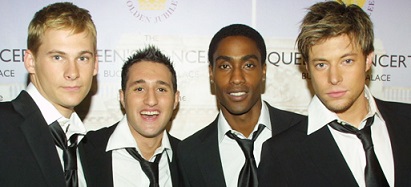
You can’t say that …. trolling Blue

‘When people threaten to blow up your family and rape your mum thats taking things too far’, said James Duncan of recently reunited Blue on Newsnight last night. The theme was internet trolls and the limits to free expression online and on twitter.

‘Its easy to say oh there’s just trolls, but when people make rape and bomb threats where do you draw the line? Do you wait for someone to get raped or bombed?’

My mum was absolutely petrified, Duncan claims. But did he really believe that there were anti-Blue terrorists just waiting to strike?

He then changed tack and made another argument – trolling is serious because someone committed suicide. So now its not the actual threat, the fear that they could be real, its the hurt of the actual insult that Duncan feels is problematic. Is Duncan taking these threats seriously, or is it really a case of there are some things you really shouldnt say, especially when it upsets my Mum?

‘We cant have that. We’ve got thick skin. We’ve grown thick skin over the years. Thats why I dont post things about Blue on twitter anymore. I dont ask what people think of our new single because I’m going to get ‘your bands, duh duh’. And you know I can’t be bothered with that’.

Blue are clearly jumping on the bandwagon of the anti-trolling debate fuelled by those who want to tell people what they can and can’t say in the unruly online world.

You can’t say that…. you wear too much makeup!

There is a website called ask where everyone can be anonyomous in their questions, but you can see who you are asking questions to. Not surprisingly this is a great opportunity for kids to ask cruel questions to people they know. Like why are you so fat Simon? Why are your lips so big Andrew? Or why have you got no friends Saleem? The standard playground stuff that as we grow older develops into good humoured banter.

A girl had been invited on to describe how she was told anonymously that she wore too much make up amongst other things. She had left the site as a result.

A boy had been told his dead brother must have experienced a lot of pain before he died. It turned out that it was one of his best friends. He’s still on the site but is no longer friends with the ‘abuser’.

If you can’t say something nice, then don’t say anything, argued an expert invited to comment on Radio 4 this morning.

Increasingly though the message is if you can’t say something nice, then you can’t say anything unless you want to be arrested. Currently this only applies online. But no doubt calling people names and being nasty will soon become a crime in real life.  Oh hang on, it already has. On the football terraces.

You can’t say that…. predatory teenagers and underage sex

A recent prase used by a judge in a case of underage sex has aroused controversy.The girl in question was said to have behaved in a predatory fashion with the man she had sex with. She looked like she was older and she came on to me, the man, in his forties, had claimed.

But predatory is something that simply can’t be said because apparently it can’t be true, and even if it is true its not an excuse.

It can’t be true because girls are ‘vulnerable’. According to a legal expert on Radio 4 this morning, ‘the behaviour of the victim often reflects the behaviour they have suffered. And many victims do behave in sexually inappropriate ways’, said the legal expert. So  if a girl is sexually provocative it can’t actually be described as sexually provocative because her behaviour is the result of some sort of damage or abuse when she was even younger.

So ‘sexually inappropriate’, is ok to say, ‘predatory behaviour’, is not allowed. This is because girls under the age of 16 can never actually want sex. Even if they think they do. And because no one should have sex with girls under the age of 16, even if they dont think she is over 15.

Is that clear?

You can’t say that…. Bongo Bongo land

Apparently there are some things you just can’t say, some words that are so offensive, so wrong, that their use is beyond the pale.

Bongo bongo land is the latest phrase to provoke the condemnation of moral linguists.

What is interesting about many applications of speech etiquette is that it isnt what is said so much as the phrases used to say something. There is a right way of saying something, and a wrong way of saying something. Even though we can all agree to the truth of what is being said.

So last week the government was condemned for the wording of a billboard which said ‘go home’ – even though everyone involved in this condemnation supports some form of border controls, and therefore, the denial of liberty and the forced deportation of individuals who don’t carry a UK passport.

This latest ‘no no’ – bongo bongo land – was used to express the view that foreign aid does not go to the poor, does not aid development, but goes to a rich elite in the developing world. This view is so uncontroversial as to be common sense amongst the intelligentsia in the west. Governments act on this view by imposing ‘poverty reduction’ conditionality on aid.

Another common view is that we shouldn’t be sending aid to foreign countries when we have poverty here at home. This is not so popular amongst the intelligentsia in the west, but it is common view – sometimes reflecting the frustration that people feel that the government is not doing anything for them.

Godfrey Bloom’s view is also slightly more nuanced. He argued that the government shouldn’t be choosing its own charities and using our tax money to directly fund charities. A valid question you might think, even if you agree with the policy.

I happen to have my own views of aid. But condemning the use of bongo bongo land isnt going to convince anyone that I’m right.